

If your child’s canine tooth is stuck and won’t come in, book an orthodontic exam with x-rays now rather than waiting. A canine that can’t break through is called an impacted canine. It is the second most commonly stuck tooth after wisdom teeth, and it shows up in about 1.5% to 2% of people. Most upper canines should be easy to feel as a bump above the baby tooth by age 10 or 11. If a girl’s canine hasn’t arrived by about 12, or a boy’s by about 13, it is considered late. Caught between ages 10 and 13, the first step may be as simple as removing the baby canine so the adult one has a clear path. Caught later, it usually means a small surgery to uncover the tooth and braces to guide it into place. Either way, the earlier the tooth’s position is known, the more options your child has. You can start with a free orthodontic consultation in Vacaville, and the practice’s page on orthodontics for children explains how the practice approaches early checkups.
For a broader look at teeth that get stuck, including canines, see the practice’s page on impacted teeth.
Quick answer: Don’t wait and see with a stuck canine. See an orthodontist for an exam and x-rays. Between ages 10 and 13, removing the baby canine and making space may help the adult tooth come in on its own. If it doesn’t, or the canine is found later, the usual plan is surgical exposure by an oral surgeon plus braces to bring the tooth down.
Vacaville parents often ask about this, usually after a dentist mentions that a baby tooth is “hanging on” or a canine “isn’t where it should be.” This post walks through what is happening, what Dr. Yang looks for, and what the choices are, so the next appointment feels less like a surprise. Dr. Yang wants parents to understand the plan before any treatment starts, because a stuck canine is a problem where timing changes the answer.
Why the Canine Is the Tooth That Gets Stuck
The upper canines, sometimes called eye teeth, have the longest trip of any front tooth. They start forming high up near the base of the nose and travel down for years before they reach the gumline. They are also among the last front teeth to arrive, so by the time they get there, the space may already be crowded or taken.
About two out of three impacted upper canines end up tilted toward the roof of the mouth. The other third sit toward the lip side, and those are more often linked to simple crowding. Research also shows a few patterns worth knowing:
- Girls are affected about twice as often as boys.
- It runs in families. If a parent or older sibling had a stuck canine, Dr. Yang pays closer attention.
- It travels with other small tooth differences. Small, peg-shaped, or missing lateral incisors (the teeth right next to the canines) are a common companion.
- About 8 percent of cases involve both sides.
A baby canine that stays firmly in place can also act like a roadblock. When the adult canine doesn’t push on it, its roots don’t dissolve, and the baby tooth just stays put.
Signs You Can Check at Home
You don’t need an x-ray to notice that something is off. Here is what Dr. Yang asks Vacaville parents to watch for, usually starting around age 10:
- A baby canine that is still solid well into the preteen years, with no wiggle at all.
- One side came in, the other didn’t. Canines usually arrive within a few months of each other. A big mismatch is a clue.
- No bump above the baby canine. Gently run a clean finger along the outside of the upper gum, above the baby canine. In most kids, you can feel the adult tooth there as a firm bulge by 10 or 11.
- A hard lump on the roof of the mouth behind the front teeth.
- The tooth next door starts tipping or spreading out, or a gap appears where the canine should be.
None of these signs means something is definitely wrong. They mean it is time to look. Dr. Yang considers these home checks a reason to schedule an exam, not a reason to worry.
Why Waiting Can Cost More Than Time
The main risk of a stuck canine isn’t the canine itself. It is the tooth next to it. A canine that drifts off course can press against the roots of the front teeth and slowly wear them down, a process called root resorption. Studies show this damage happens most often between ages 11 and 12, and it rarely starts after age 14. That window lines up almost exactly with the years when parents are told to “wait and see.”
Timing also changes how well treatment works. A canine is considered late if it hasn’t come in by about 12 in girls and 13 in boys. Removing the baby canine works best around ages 10 to 13, with a review about 12 months later to see whether the adult canine has improved. In adults, a stuck canine usually won’t come in on its own. Guiding it into place is still possible, but success rates drop and treatment takes considerably longer.
This is why Dr. Yang follows the American Association of Orthodontists’ recommendation for a first orthodontic visit by age seven. The goal at that age isn’t to start braces. It is to set a baseline, so that by 9 or 10 it is already clear whether the canines are on track. Dr. Yang believes early evaluation is what keeps a simple problem from turning into a complex one, and it is the same reason Natalie Yang Orthodontics offers early orthodontic care for kids starting at age six.
| Age | What usually happens | What it means for a stuck canine |
| 7 | First orthodontic screening (AAO recommendation) | Baseline exam; the orthodontist checks spacing and the developing teeth |
| 8 to 10 | Yearly checks of the canine area | Feeling for the canine bump becomes meaningful |
| 10 to 11 | Adult canine should be easy to feel above the baby tooth | No bump by now is a reason for x-rays |
| 10 to 13 | Best window for removing the baby canine | Simplest first step; progress is reviewed about 12 months later |
| 11 to 12 | Peak risk of damage to neighboring roots | Finding the canine’s position matters most now |
| About 12 (girls), 13 (boys) | Canine considered late if still missing | Surgical exposure and braces become the usual plan |
How Dr. Yang Finds Out Where the Canine Is Hiding
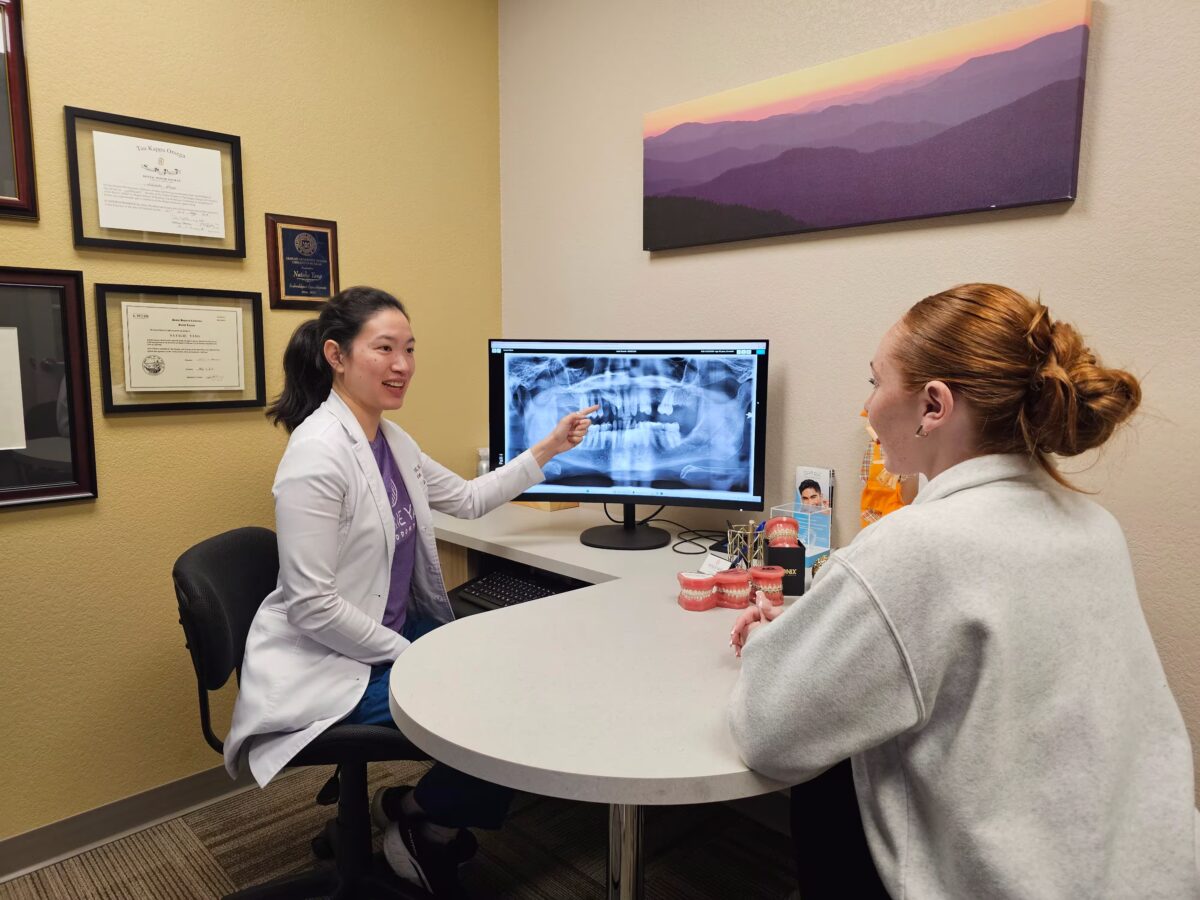
At the first visit, Dr. Yang starts with what she can see and feel: which baby teeth are loose, whether the canine bump is present, and how much room there is in the arch. The office’s iTero digital scanner creates a precise 3D model of the teeth without goopy impressions, which helps when measuring space.
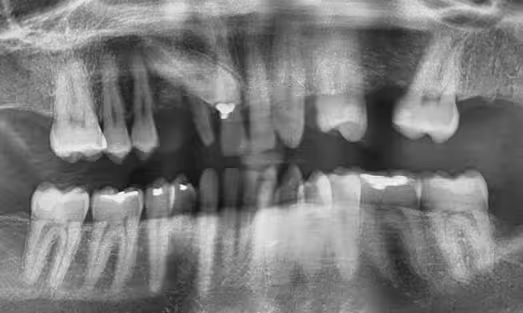
To see the canine itself, x-rays are needed. A panoramic x-ray shows the whole picture. To tell whether the tooth is sitting toward the lip or toward the palate, orthodontists often compare two x-rays taken from slightly different angles. When a canine is close to the roots of other teeth, a 3D scan of the area can show exactly how close, and whether any root damage has started. Dr. Yang only recommends that extra imaging when a regular x-ray can’t answer the question, because the goal is the right information with the least radiation.
Option 1: Clearing the Path Early (Ages 10 to 13)
If the canine is caught heading off course while your child is still between about 10 and 13, the first step is often the simplest one: remove the baby canine. Without that roadblock, the adult canine sometimes corrects its own path. In the original study on this approach, about 78 percent of off-course canines straightened out after the baby tooth came out. A later study found about 62 percent. Results are best when the canine isn’t badly displaced and when there is no crowding.
Taking out the baby canine at the right age may help the permanent one erupt on its own, but the research is not strong enough to be sure, so Dr. Yang reviews progress and has a backup plan. Follow-up x-rays track the canine, and if it hasn’t improved within about 12 months, the plan moves to the next option.
Space matters too. If the arch is crowded, room may need to be held or opened so the canine has somewhere to land. Depending on your child’s bite, that can involve braces or a palatal expander, which widens the upper jaw to relieve crowding while kids are still growing. Dr. Yang decides on space-making only after looking at the whole bite, since every child’s arch is different.
Option 2: Uncovering the Tooth and Guiding It Into Place
When the canine is too far off course, or your child is older, the most common plan has two partners: an oral surgeon and your orthodontist.
- Make room first. Braces line up the other teeth and open a space wide enough for the canine.
- Expose the tooth. The oral surgeon makes a small opening in the gum to uncover the canine. In an open exposure, the tooth is left visible so the orthodontist can attach to it directly. In a closed exposure, the surgeon bonds a tiny bracket with a thin gold chain to the tooth, then closes the gum back over it, leaving only the chain showing.
- Guide it down slowly. The chain is connected to the braces, and gentle, steady pressure over several months brings the canine into the arch.
- Finish and hold. Once the canine is in place, Dr. Yang fine-tunes the bite and follows up with retainers.
Research hasn’t found a clear difference between open and closed exposure. The choice depends on where the tooth sits and what the surgeon and orthodontist agree is best. Orthodontists across the country handle this step in similar ways. Dr. Tate Chauncey, an orthodontist at Chauncey Orthodontics in Henderson, NV, explains: “Dr. Chauncey will open space and work with a surgeon for exposure. Sometimes it’s an open exposure, sometimes closed. He does also use Isoglide for efficiency.” Like Dr. Chauncey, Dr. Yang sees opening space and close teamwork with the surgeon as the core of this treatment.
Natalie Yang Orthodontics also offers TAD-supported orthodontics. Temporary anchorage devices are tiny, temporary anchors that provide a steady point to pull from, which can help with precise control in complex cases like a canine that has to travel a long way. Dr. Yang uses tools like TADs when they make tooth movement more predictable, not as a default for every patient.
Most kids handle exposure surgery well. It is usually a short procedure, and soreness tends to settle within a few days. The chain is barely visible, and once it’s attached to the braces, most kids stop noticing it.
Option 3: When the Canine Can’t Be Saved
Occasionally, a canine is stuck so deeply, or at such a sharp angle, that pulling it down isn’t practical. A tooth can also fuse to the surrounding bone, which means it won’t move no matter how much force is applied. In those cases, the options include removing the canine and using braces to move the next tooth back so it takes the canine’s place, keeping the baby canine as long as it stays healthy, or planning a future replacement tooth with your family dentist. A deep canine causing no harm can sometimes be left alone and watched with regular checkups.
These are rarer paths, and they’re another reason early detection matters. Dr. Yang would much rather discuss Option 1 with a 10-year-old than Option 3 with a 16-year-old.
What to Do This Week
If you’re reading this because your child has a canine that hasn’t shown up, here’s a simple plan:
- Check the timeline. Is your child past 11 with no canine bump, or past 12 or 13 with a baby canine still solid?
- Ask your dentist whether recent x-rays show where the canine is sitting, and request a copy.
- Book an orthodontic exam. The free consultation at Natalie Yang Orthodontics includes an exam and a clear explanation of the findings. For families coming from Fairfield, Dixon, or anywhere else in Solano County, the office at 3000 Alamo Drive #201 is a short drive off I-80.
- Ask about coverage. Natalie Yang Orthodontics accepts all major PPO plans and handles claims for families. Details are on the orthodontic insurance page and the braces payment plans page.
A stuck canine can sound alarming, but it is a well-understood problem with clear, step-by-step solutions. The most important thing a parent can do is not wait. Dr. Yang’s approach is to find the tooth, explain every option, and start with the least invasive one that has a real chance of working.
Questions Parents Ask About Impacted Canines
Will my child’s impacted canine come in on its own?
Sometimes, if it is caught early. Taking out the baby canine between about ages 10 and 13 may help the adult canine come in on its own, but the research is not strong enough to be sure, so progress is reviewed about 12 months later. In adults, a stuck canine usually won’t come in on its own.
Does surgery to uncover an impacted canine hurt?
The exposure is a short procedure done by an oral surgeon with numbing, and many kids are also offered sedation. Most children feel sore for a few days and manage with soft foods and over-the-counter pain relief. The braces that guide the tooth down afterward feel like regular braces adjustments.
How long does it take to bring an impacted canine into place?
It depends on how far the canine has to travel and the angle it sits at. Guiding the tooth down often takes several months on its own, and it is usually part of a full braces treatment that runs longer. Older teens and adults generally need more time than younger patients.
Can a stuck canine damage my child’s other teeth?
Yes, that is the main reason not to wait. An off-course canine can press on the roots of the front teeth beside it and slowly wear them down, most often around ages 11 to 12. An orthodontic exam with x-rays can show whether this is happening and how quickly treatment should start.
Sources
- Royal College of Surgeons of England, Faculty of Dental Surgery. Management of the Palatally Ectopic Maxillary Canine (clinical guideline, 2022, revised 2023). Used for: 1.5% prevalence, palpable by 10 to 11, late eruption ages, root-damage window, baby-canine extraction (78% and 62%, ages 10 to 13, 12-month review), adult outcomes, removal and observation options.
- Impacted canines: etiology, diagnosis, and orthodontic management (review article, PubMed Central). Used for: about 2% prevalence, twice as common in girls, 8% bilateral, one-third lip side and two-thirds palate side, association with small lateral incisors.
- Benson PE, Atwal A, Bazargani F, Parkin N, Thind B. Interventions for promoting the eruption of palatally displaced permanent canine teeth, without the need for surgical exposure, in children aged 9 to 14 years. Cochrane Database of Systematic Reviews 2021, CD012851. Used for: extraction of the baby canine may help, but the evidence is very uncertain.
- Parkin N, Benson PE, Thind B, Shah A, Khalil I, Ghafoor S. Open versus closed surgical exposure of canine teeth that are displaced in the roof of the mouth. Cochrane Database of Systematic Reviews 2017, CD006966. Used for: no clear difference between open and closed exposure.
- Impacted maxillary canines: a perennial problem, Dental Update. Used for: palatal impaction as the most common canine impaction seen by orthodontists.
- American Association of Orthodontists recommendation for a first orthodontic check by age 7, as stated on Natalie Yang Orthodontics’ children’s page.